CommandService
Overview
The CommandService is a core component of the framework that facilitates the management and synchronization of commands. It primarily provides methods for publishing both full commands and partial commands, allowing for their processing either synchronously or asynchronously, thereby enhancing the overall efficiency and flexibility of command handling within the system.
CommandModule Configuration
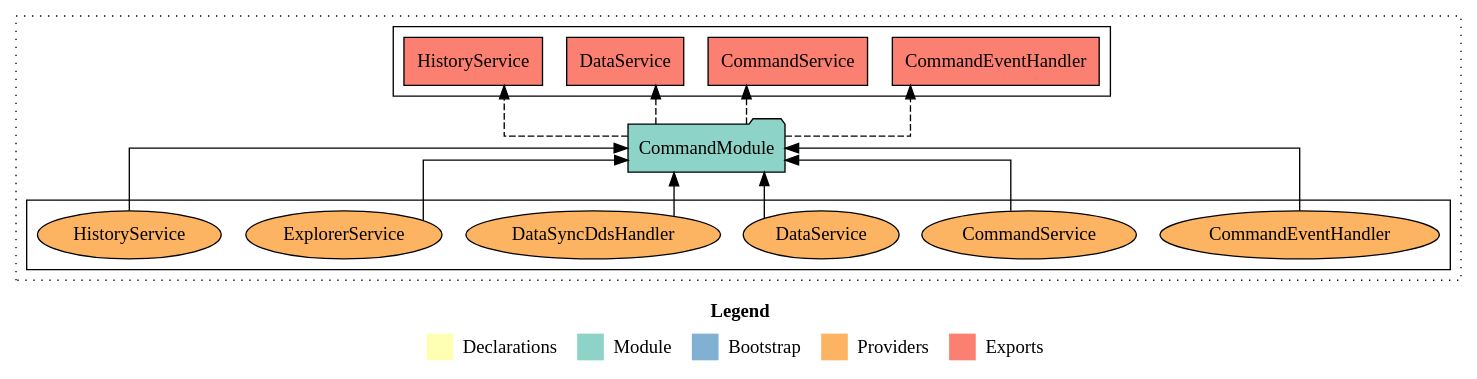
The CommandModule is a dynamic module used to register data sync handlers and provide services associated with a table name. When importing this module, you must provide a specific option for use.
Register Options
| Property | Description |
|---|---|
tableName: string | Provide table name |
skipError?: boolean | Reserved for future use. Not yet implemented. |
dataSyncHandlers?: Type<IDataSyncHandler>[] | Register data sync handlers |
disableDefaultHandler?: boolean | If set to true, disables the default DynamoDB data sync handler |
Registration Example
import { CommandModule } from '@mbc-cqrs-serverless/core';
import { Module } from '@nestjs/common';

@Module({
  imports: [
    CommandModule.register({
      tableName: 'cat',
      dataSyncHandlers: [CatDataSyncRdsHandler],
    }),
  ],
})
export class CatModule {}
Here, the CommandModule registers with the cat table name and provides the CatDataSyncRdsHandler to the data sync handlers.
Using CommandService
In the example for the method below, assume you import the CommandModule into your module as follows:
import { CommandModule } from "@mbc-cqrs-serverless/core";
import { Module } from "@nestjs/common";

import { CatDataSyncRdsHandler } from "./handler/cat-rds.handler";
import { CatController } from "./cat.controller";
import { CatService } from "./cat.service";

@Module({
  imports: [
    CommandModule.register({
      tableName: "cat",
      dataSyncHandlers: [CatDataSyncRdsHandler],
    }),
  ],
  controllers: [CatController],
  providers: [CatService],
})
export class CatModule {}
Then, the CommandService and DataService will be ready for injection into other services for your use.
For complete CRUD implementation patterns using CommandService, see Service Patterns.
Methods
async publishAsync(input: CommandInputModel, options: ICommandOptions): Promise<CommandModel | null>
Utilize this method to publish a full command, as it will insert the command data into the command table.
The method provides immediate feedback by returning the command data right away, allowing you to proceed without waiting for the command to be processed. Subsequently, the command is handled asynchronously in the background, ensuring that your application remains responsive while the processing occurs.
Return Value: Returns Promise<CommandModel | null> — the CommandModel on success, or null when the command is not dirty (no changes detected compared to the existing command).
For example, you can publish a new cat command as below:
import { basename } from 'path';
import {
  generateId,
  getCommandSource,
  VERSION_FIRST,
} from "@mbc-cqrs-serverless/core";

// class CatCommandDto extends CommandDto {}

const catCommand = new CatCommandDto({
  pk: catPk,
  sk: catSk,
  tenantCode,
  id: generateId(catPk, catSk),
  code,
  type: "CAT",
  name: attributes.name,
  version: VERSION_FIRST,
  attributes,
});

const commandSource = getCommandSource(
  basename(__dirname),
  this.constructor.name,
  "createCatCommand"
);

const item = await this.commandService.publishAsync(catCommand, {
  source: commandSource,
  invokeContext,
});
async publishPartialUpdateAsync( input: CommandPartialInputModel, options: ICommandOptions): Promise<CommandModel | null>
This method allows you to create new command data based on the previous command with the same pk and sk (primary key) values.
Like publishAsync, this method immediately returns the updated command data without waiting for the command to be processed.
Return Value: Returns Promise<CommandModel | null> — the CommandModel on success, or null when the command is not dirty (no changes detected compared to the existing partial command).
For example, you want to update cat's name:
import { basename } from 'path';
import { generateId, getCommandSource } from "@mbc-cqrs-serverless/core";

// ...

const catCommand: CommandPartialInputModel = {
  pk: catPk,
  sk: catSk,
  version: storedItem.version,
  name: attributes.name,
};

const commandSource = getCommandSource(
  basename(__dirname),
  this.constructor.name,
  "updateCatCommand"
);

const item = await this.commandService.publishPartialUpdateAsync(catCommand, {
  invokeContext,
});
async publishSync( input: CommandInputModel, options: ICommandOptions): Promise<CommandModel | null>
This method serves as a synchronous counterpart to the publishAsync method, meaning that it will halt the execution of the code until the command has been fully processed. This ensures that you receive the result of the command before proceeding with any further operations in your code.
Since v1.2.0, publishSync() and publishPartialUpdateSync() return null when the command is not dirty (no-op). Always null-check the result before accessing properties:
const result = await this.commandService.publishSync(command, { invokeContext });
if (!result) return; // no-op: command was not dirty, nothing was written
console.log(result.pk); // safe after null check
Since v1.1.4, publishSync writes a full audit trail matching the async pipeline:
- An immutable event is written to the Command table with
syncMode: 'SYNC'marker - The History table is populated, providing complete Event Sourcing parity
- Command lifecycle:
publish_sync:STARTED→finish:FINISHED(orpublish_sync:FAILEDon error) - Returns
nullwhen the command is not dirty (no-op), matchingpublishAsyncbehavior - DynamoDB Stream filter excludes
syncMode=SYNCrecords to prevent Step Functions double-execution
Prior to v1.1.4, publishSync bypassed the Command table to avoid triggering Step Functions, resulting in a missing audit trail and no History table entries.
In versions prior to v1.3.2, publishSync had two bugs: the versioned sk was not assigned to command.sk before handler dispatch (causing IDataSyncHandler.up() to receive the wrong sort key), and errors from updateStatus were silently masked.
See also: Changelog v1.3.2
Returns null if no changes are detected (dirty check optimization).
For example:
import {
  generateId,
  getCommandSource,
  VERSION_FIRST,
} from "@mbc-cqrs-serverless/core";

// class CatCommandDto extends CommandDto {}

const catCommand = new CatCommandDto({
  pk: catPk,
  sk: catSk,
  tenantCode,
  id: generateId(catPk, catSk),
  code,
  type: "CAT",
  name: attributes.name,
  version: VERSION_FIRST,
  attributes,
});

const commandSource = getCommandSource(
  basename(__dirname),
  this.constructor.name,
  "createCatCommandSync"
);

const item = await this.commandService.publishSync(catCommand, {
  source: commandSource,
  invokeContext,
});
async publishPartialUpdateSync( input: CommandPartialInputModel, options: ICommandOptions): Promise<CommandModel | null>
This method is a synchronous version of the publishPartialUpdateAsync method. It will block the execution of the code until the command is processed.
Since v1.2.0, this method returns null when the command is not dirty (no-op). Always null-check the result. See publishSync null return for details.
This method requires the version field in the input to match the current version of the existing item. If the item is not found or the version does not match, a BadRequestException is thrown with the message "Invalid input: item not found or version mismatch" (prior to v1.0.25, the message was "The input is not a valid, item not found or version not match").
For example, you want to update cat's name:
import { basename } from 'path';
import { generateId, getCommandSource } from "@mbc-cqrs-serverless/core";

// ...

const catCommand: CommandPartialInputModel = {
  pk: catPk,
  sk: catSk,
  version: storedItem.version,
  name: attributes.name,
};

const commandSource = getCommandSource(
  basename(__dirname),
  this.constructor.name,
  "updateCatCommandSync"
);

const item = await this.commandService.publishPartialUpdateSync(catCommand, {
  source: commandSource,
  invokeContext,
});
async publish(input: CommandInputModel, options: ICommandOptions): Promise<CommandModel | null> removed
This method was removed in v1.1.0. Use publishAsync method instead.
For example, you can publish a new cat command as below:
import { basename } from 'path';
import {
  generateId,
  getCommandSource,
  VERSION_FIRST,
} from "@mbc-cqrs-serverless/core";

// class CatCommandDto extends CommandDto {}

const catCommand = new CatCommandDto({
  pk: catPk,
  sk: catSk,
  tenantCode,
  id: generateId(catPk, catSk),
  code,
  type: "CAT",
  name: attributes.name,
  version: VERSION_FIRST,
  attributes,
});

const commandSource = getCommandSource(
  basename(__dirname),
  this.constructor.name,
  "createCatCommand"
);

const item = await this.commandService.publish(catCommand, {
  source: commandSource,
  invokeContext,
});
The method returns the command data.
async publishPartialUpdate( input: CommandPartialInputModel, options: ICommandOptions): Promise<CommandModel | null> removed
This method was removed in v1.1.0. Use publishPartialUpdateAsync method instead.
This method allows you to create new command data based on the previous command.
For example, you want to update cat's name:
import { basename } from 'path';
import { generateId, getCommandSource } from "@mbc-cqrs-serverless/core";

// ...

const catCommand: CommandPartialInputModel = {
  pk: catPk,
  sk: catSk,
  version: storedItem.version,
  name: attributes.name,
};

const commandSource = getCommandSource(
  basename(__dirname),
  this.constructor.name,
  "updateCatCommand"
);

const item = await this.commandService.publishPartialUpdate(catCommand, {
  source: commandSource,
  invokeContext,
});
The method returns the updated command data.
async reSyncData(): Promise<void>
If you want to reapply the data sync handler, this method is designed for you to use. You only need to call the function as follows:
await this.commandService.reSyncData();
async getItem(key: DetailKey): Promise<CommandModel | null>
Retrieves a command item by its primary key. If the sort key does not include the version separator (@, e.g. CAT#cat001@2), it automatically calls getLatestItem to get the latest version. Returns null when no matching item is found.
import { DetailKey } from "@mbc-cqrs-serverless/core";

// Get a specific version of a command
const command = await this.commandService.getItem({
  pk: "CAT#tenant1",
  sk: "CAT#cat001@2", // Includes version number
});

// If no version in sk, automatically gets latest version
const latestCommand = await this.commandService.getItem({
  pk: "CAT#tenant1",
  sk: "CAT#cat001",
});
async getLatestItem(key: DetailKey): Promise<CommandModel | null>
Retrieves the latest version of a command item by its primary key. This method uses a lookup algorithm that starts from the data table's version and searches up/down to find the most recent command version. Returns null when no matching item is found.
import { DetailKey } from "@mbc-cqrs-serverless/core";

const latestCommand = await this.commandService.getLatestItem({
  pk: "CAT#tenant1",
  sk: "CAT#cat001", // Sort key without version
});

if (latestCommand) {
  console.log(`Latest version: ${latestCommand.version}`);
}
async getNextCommand(currentKey: DetailKey): Promise<CommandModel | undefined>
Retrieves the next version of a command based on the current command's key. Returns undefined if the next version does not exist. This is useful for processing command chains or implementing retry logic.
import { DetailKey } from "@mbc-cqrs-serverless/core";

const currentKey: DetailKey = {
  pk: "CAT#tenant1",
  sk: "CAT#cat001@2",
};

const nextCommand = await this.commandService.getNextCommand(currentKey);
// Returns command with sk: "CAT#cat001@3" if it exists, otherwise undefined
if (nextCommand) {
  // Process the next command
}
async updateStatus(key: DetailKey, status: string, notifyId?: string): Promise<void>
Updates the status of a command and sends an SNS notification. This is commonly used to update task or process statuses and notify subscribers of the change.
import { DetailKey } from "@mbc-cqrs-serverless/core";

const key: DetailKey = {
  pk: "CAT#tenant1",
  sk: "CAT#cat001@1",
};

// Update status and send SNS notification
await this.commandService.updateStatus(key, "COMPLETED");

// With custom notification ID
await this.commandService.updateStatus(key, "FAILED", "custom-notify-id");
The SNS notification payload includes:
action:"command-status"pk,sk: The command keytable: The command table nameid: Notification ID (custom or auto-generated)tenantCode: Extracted from pkcontent: Object containingstatusandsource
async duplicate(key: DetailKey, options: ICommandOptions): Promise<CommandModel>
Creates a duplicate of an existing command with an incremented version number. The duplicated command will have source set to "duplicated" and updated metadata (timestamp, user, IP).
import { DetailKey, getCommandSource } from "@mbc-cqrs-serverless/core";
import { basename } from "path";

const key: DetailKey = {
  pk: "CAT#tenant1",
  sk: "CAT#cat001@1",
};

const commandSource = getCommandSource(
  basename(__dirname),
  this.constructor.name,
  "duplicateCatCommand"
);

const duplicatedCommand = await this.commandService.duplicate(key, {
  source: commandSource,
  invokeContext,
});

// The duplicated command has:
// - version incremented by 1
// - source set to "duplicated"
// - updated timestamps and user info
async updateTaskToken(key: DetailKey, token: string): Promise<CommandModel>
Stores an AWS Step Functions task token on a command item. This is used when integrating with Step Functions to enable callback patterns.
import { DetailKey } from "@mbc-cqrs-serverless/core";

const key: DetailKey = {
  pk: "CAT#tenant1",
  sk: "CAT#cat001@1",
};

// Store the Step Functions task token
await this.commandService.updateTaskToken(key, event.taskToken);

// Later, use the token to send task success/failure
// via SendTaskSuccessCommand or SendTaskFailureCommand
async updateTtl(key: DetailKey): Promise<any | null>
Updates the TTL (Time To Live) of the previous version of a command. This is typically used internally to manage command history retention. Returns null if the version is too low or the previous command doesn't exist.
import { DetailKey } from "@mbc-cqrs-serverless/core";

const key: DetailKey = {
  pk: "CAT#tenant1",
  sk: "CAT#cat001@3", // Version 3
};

// Updates TTL of version 2 (previous version)
const result = await this.commandService.updateTtl(key);
This method is primarily used internally by the framework for command history management. Direct usage is rarely needed in application code.
dataSyncHandlers (getter): IDataSyncHandler[]
Returns the array of registered data sync handlers for this CommandService instance. This is useful when you need to inspect or iterate over the handlers programmatically.
// Get all registered data sync handlers
const handlers = this.commandService.dataSyncHandlers;

handlers.forEach((handler) => {
  console.log(`Handler: ${handler.constructor.name}, Type: ${handler.type}`);
});
getDataSyncHandler(name: string): IDataSyncHandler | undefined
Retrieves a specific data sync handler by its class name. Returns undefined if no handler with the specified name is found.
// Get a specific handler by name
const rdsHandler = this.commandService.getDataSyncHandler('CatDataSyncRdsHandler');

if (rdsHandler) {
  // Use the handler directly
  await rdsHandler.up(commandModel);
}
isNotCommandDirty(item: CommandModel, input: CommandInputModel): boolean
Compares an existing command item with a new input to determine if there are any actual changes. Returns true if the command is NOT dirty (no changes), returns false if there ARE changes.
This method is used internally by publish methods to skip unnecessary writes when no changes are detected. You can also use it directly to check if an update would result in any changes before calling publish.
// Check if an update would result in changes
const existingCommand = await this.commandService.getItem({ pk, sk });

if (existingCommand && this.commandService.isNotCommandDirty(existingCommand, newInput)) {
  // No changes detected, skip the update
  console.log('Command has no changes, skipping update');
  return existingCommand;
}

// Proceed with the update
const result = await this.commandService.publishAsync(newInput, options);
tableName (getter/setter): string
Gets or sets the DynamoDB table name for this CommandService instance. The table name is configured when registering the CommandModule, but can be changed at runtime if needed.
// Get the current table name
const currentTable = this.commandService.tableName;
console.log(`Operating on table: ${currentTable}`);

// Set a different table name
this.commandService.tableName = 'another-table';
Changing the table name at runtime is an advanced use case. In most applications, you should configure the table name through CommandModule.register() and not change it afterwards.
Read-Your-Writes (RYW) Consistency
Read-Your-Writes consistency was added in v1.2.0.
The Problem: Stale Reads After publishAsync
publishAsync returns immediately after writing to the Command table, then the DynamoDB Stream pipeline asynchronously syncs the data to the read model (Data table). This creates a short window where a subsequent read by the same user returns stale data — for example, a "Create Order" button submits successfully, the user is redirected to the order list, but the new order does not appear yet.
User Action                 DynamoDB Stream          User Sees
──────────────────────────────────────────────────────────────────
POST /orders ──────────► publishAsync() ─────► Command table ✓
                                                      │
GET  /orders ──────────► DataService.list() ─► Data table   ✗  ← stale!
                                                      │
                         [Stream sync ~1-3s]          │
                                          ↓           ▼
GET  /orders ──────────► DataService.list() ─► Data table   ✓  ← fresh
The Solution: Session-Based Merge
RYW bridges this gap by temporarily caching the version number of the pending command in a short-lived session table. When reading through Repository, the session entry is detected and the pending command is fetched from the Command table and merged into the response — making the write immediately visible to the user who made it.
User Action                 With RYW                 User Sees
──────────────────────────────────────────────────────────────────
POST /orders ──────────► publishAsync()
                         ├─► Command table ✓
                         └─► Session table (TTL=5m)

GET  /orders ──────────► Repository.listItemsByPk()
                         ├─► Session table ─► found! version=3
                         ├─► Command table  ─► fetch pending cmd
                         └─► merge into result     ✓  ← fresh!
How it Works (Internals)
-
Write path — after a successful
publishAsync,CommandServicewrites a session entry to{NODE_ENV}-{APP_NAME}-sessiontable:- PK:
{userId}#{tenantCode} - SK:
{moduleTableName}#{itemId} version: the version number of the published commandttl: current time +RYW_SESSION_TTL_MINUTESseconds (DynamoDB TTL auto-deletes the entry)- Note: if
RYW_SESSION_TTL_MINUTESis unset, this write is skipped entirely.Repositoryreads still work correctly — they simply find no session entries and fall back toDataService.
- PK:
-
Read path —
Repositorychecks the session table before returning data:- For
getItem: if a session entry exists, fetches the exact versioned command and merges it with any existing data item - For
listItemsByPk: fetches all session entries for the user/tenant/module, then applies updates, deletes, and create-new prepends to the base list result - For
listItems(external sources like RDS): same merge logic, withtransformCommandto convert the command shape to the external query shape. UnlikelistItemsByPk(which derivestenantCodefrom thepkargument),listItemsderivestenantCodefromgetUserContext(options.invokeContext)— sooptionswith a validinvokeContextis required for RYW to activate
- For
-
Session expiry — entries expire automatically via DynamoDB TTL. Once the Stream sync completes (typically 1–3 seconds), the session entry is redundant and will be cleaned up within the TTL window.
Proactive Session Cleanup (v1.2.6+)
Proactive RYW session cleanup and the getVersion short-circuit were added in v1.2.6.
Prior to v1.2.6, RYW sessions persisted until their TTL expired, even after the data table had absorbed the corresponding write. This created a "stale override" window: if another user or external system updated the same item to a newer version, the session would still cause the originating user to see their own older command merged on top of the data table — effectively reverting visible state until the TTL elapsed.
Since v1.2.6, Repository actively purges sessions in the background once the data table version meets or exceeds the session version. This guarantees that:
- The originating user immediately sees the latest data once the Stream sync completes — no more stale-override window
- Subsequent reads skip the unnecessary command-table lookup, reducing latency
- The session table stays small even when the configured TTL is generous
Cleanup is fire-and-forget — failures are logged as warnings (Failed to delete RYW session (non-fatal): ...) and never block the read path. All behavior is automatic when RYW_SESSION_TTL_MINUTES is enabled; no application code changes are required.
Optional: getVersion short-circuit for RDS read models
Repository.listItems() (the RDS path) now accepts an optional mergeOptions.getVersion callback. If your RDS rows already carry a version column, supplying this callback lets the merge loop skip the extra DynamoDB GetItem when the existing RDS row already proves caught-up:
await repository.listItems(
  () => rdsQuery(),
  {
    latestFlg: true,
    transformCommand: (cmd) => ({
      id: cmd.id,
      version: cmd.version,
      // ...map other CommandModel fields to your RDS row shape
    }),
    getVersion: (item) => item.version, // new in v1.2.6
  },
  options,
)
Note: getVersion only short-circuits the update path (when the session's itemId matches an existing RDS row). Create-new items (session present but not yet reflected in RDS) still fetch the command as before — there is no existing row to derive a version from.
Enabling RYW
Step 1: Set the environment variable
Set RYW_SESSION_TTL_MINUTES to a positive integer. A value of 5 (minutes) is a safe default — it covers any Stream sync delay while keeping the session table small.
RYW_SESSION_TTL_MINUTES=5
If unset (or set to 0 or a non-number), the feature is completely disabled: session writes are skipped and Repository behaves identically to DataService.
Step 2: Create the session DynamoDB table
Add dynamodbs/session.json to your project (same location as your other table definitions):
{
  "TableName": "${NODE_ENV}-${APP_NAME}-session",
  "BillingMode": "PAY_PER_REQUEST",
  "KeySchema": [
    { "AttributeName": "pk", "KeyType": "HASH" },
    { "AttributeName": "sk", "KeyType": "RANGE" }
  ],
  "AttributeDefinitions": [
    { "AttributeName": "pk", "AttributeType": "S" },
    { "AttributeName": "sk", "AttributeType": "S" }
  ],
  "TimeToLiveSpecification": {
    "AttributeName": "ttl",
    "Enabled": true
  }
}
The table name is automatically computed as {NODE_ENV}-{APP_NAME}-session (e.g. dev-myapp-session).
Using Repository
Repository is a drop-in replacement for DataService for read operations that need RYW consistency. It is exported from @mbc-cqrs-serverless/core (via CommandModule). Register it in your module and inject it in your service.
Module registration
import { CommandModule } from '@mbc-cqrs-serverless/core'

@Module({
  imports: [
    CommandModule.register({
      tableName: 'order',
      dataSyncHandlers: [OrderDataSyncHandler],
    }),
  ],
  providers: [OrderService],
  exports: [OrderService],
})
export class OrderModule {}
Repository is automatically provided and exported by CommandModule.register() — no extra configuration is needed.
getItem — single item with RYW merge
import { DetailKey, ICommandOptions, Repository } from '@mbc-cqrs-serverless/core'
import { Injectable } from '@nestjs/common'

@Injectable()
export class OrderService {
  constructor(private readonly repository: Repository) {}

  async getOrder(key: DetailKey, options: ICommandOptions) {
    // If the user just published an async command for this item,
    // the pending version is merged in — the user always sees their own write.
    return this.repository.getItem(key, options)
  }
}
listItemsByPk — DynamoDB list with RYW merge
Pass { latestFlg: true } as the third argument to enable merging. If mergeOptions is omitted or latestFlg is false/undefined, the method behaves identically to DataService.listItemsByPk.
async listOrders(pk: string, options: ICommandOptions) {
  return this.repository.listItemsByPk(
    pk,
    { limit: 20, order: 'desc' },  // standard DynamoDB query options
    { latestFlg: true },            // enable RYW merge
    options,
  )
}
Merge behaviour per operation:
| Operation | Result |
|---|---|
| create-new | Prepended to the top of the list (sorted by updatedAt desc among multiple pending creates) |
| update | Replaced in-place — original sort position preserved |
| delete | Removed from the result |
Newly created items are prepended to the top of the list, not integrated into the caller's sort order (e.g. by name or code). They appear at the top until the DynamoDB Stream sync completes and the next read returns fully sorted data. This is intentional — RYW guarantees visibility, not sort position.
listItems — external source (RDS / Elasticsearch) with RYW merge
For services that query an external source (e.g. RDS via TypeORM or Prisma), use listItems with a transformCommand function to convert the pending command into the same shape as your query result.
import { IMergeOptions, ICommandOptions, Repository } from '@mbc-cqrs-serverless/core'
import { Injectable } from '@nestjs/common'
import { OrderDto } from './dto/order.dto'

@Injectable()
export class OrderService {
  constructor(
    private readonly repository: Repository,
    private readonly orderRepository: TypeOrmOrderRepository,
  ) {}

  async searchOrders(
    filter: OrderFilterDto,
    options: ICommandOptions,
  ): Promise<{ total: number; items: OrderDto[] }> {
    const mergeOptions: IMergeOptions<OrderDto> = {
      latestFlg: true,

      // Convert a pending CommandModel into an OrderDto
      transformCommand: (cmd, existing) => ({
        id: cmd.id,
        code: cmd.code,
        name: cmd.name,
        status: cmd.attributes?.status ?? existing?.status,
        // carry over join fields that don't exist in the command
        customerName: existing?.customerName ?? '',
        createdAt: cmd.createdAt,
        updatedAt: cmd.updatedAt,
      }),

      // Only prepend create-new items that match the current search filter
      matchesFilter: (item) =>
        !filter.status || item.status === filter.status,
    }

    return this.repository.listItems(
      // The base query — runs as normal
      () => this.orderRepository.search(filter),
      mergeOptions,
      options,
    )
  }
}
total is adjusted after merge (incremented for create-new, decremented for delete). However, prepended items sit outside the RDS LIMIT/OFFSET window, so on page 2+ there may be a one-item overlap or gap until the Stream sync completes. For most UX patterns (redirect-after-write, optimistic UI) this is unnoticeable.
Behaviour Summary
| Scenario | RYW_SESSION_TTL_MINUTES unset | RYW_SESSION_TTL_MINUTES=5 |
|---|---|---|
getItem — item just created | Returns stale (empty) | Returns pending command data |
getItem — after Stream sync | Returns fresh data | Returns fresh data (session expired or not found) |
listItemsByPk with latestFlg | Returns stale list | Returns list with pending item prepended |
| Performance overhead | None | 1–2 extra DynamoDB reads per pending item |
| Impact on existing code | None | None — DataService is unchanged |
Limitations and Trade-offs
- Visibility guarantee, not ordering: Pending create-new items appear at the top of lists, not in the caller's sort order.
- Single-user scope: RYW only applies to the user who published the command. Other users still see the eventual-consistent read until the Stream sync completes.
listItemspagination overlap: On paginated external queries (RDS), a create-new item may appear on both page 1 (prepended) and page 2 (after sync). This resolves on the next full reload.- Session table cost: Each
publishAsynccall writes one DynamoDB item per updated entity. WithRYW_SESSION_TTL_MINUTES=5the items are small and short-lived. Cost is negligible for typical workloads.
Related Documentation
- Data Service - Querying data with DynamoDB
- Unit Testing - Unit testing CommandService with mocks
- Service Patterns - Complete CRUD service implementation patterns
- Event Handling Patterns - Creating data sync handlers
- Version Conflict Guide - Handling optimistic locking conflicts
- Interfaces - TypeScript interfaces for CommandInputModel and more
- Versioning Rules - VERSION_FIRST, version sequences, and optimistic locking semantics
- Serialization - Serialization of command data with class-transformer